
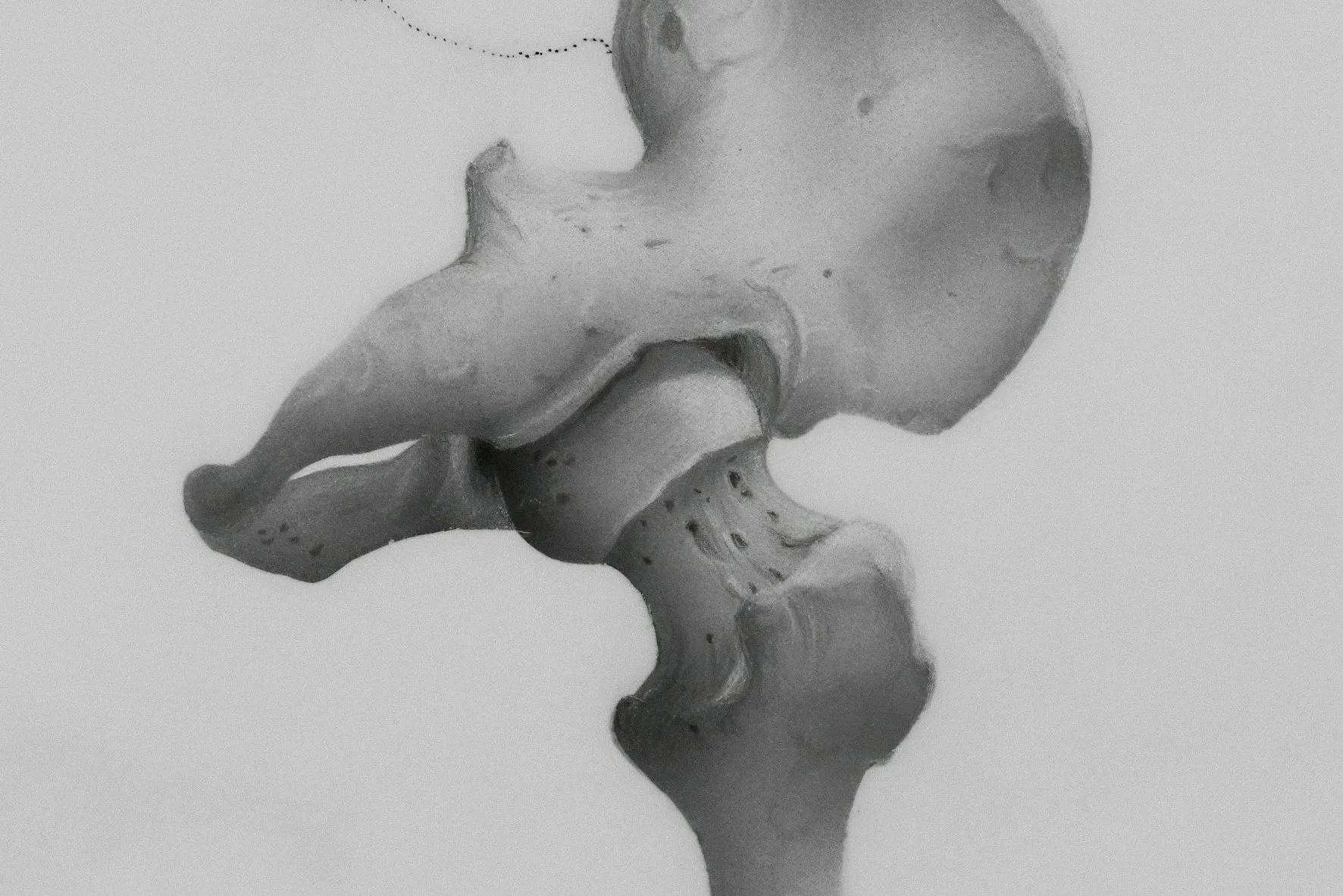
Hip Pain That Keeps Coming Back
Sitting too long ignites it. Getting out of the car is its own ritual. Going down the stairs feels like the hip might give way. Sleeping on that side is no longer an option, and you've started cheating to whichever side hurts less.
Maybe you've been told it's a labral tear. Maybe bursitis. Maybe nothing showed up clearly and you were sent home with clamshells and IT-band stretches that didn't change anything or made it worse. You're starting to wonder if anyone is actually going to figure this out and make it go away.
I'll give you a hint. It's not that your hip is going. It's not just because of a labral tear or bursitis — no matter what the imaging said.
"After the first session all of my pain was gone."
-Joanne O.
Why It Keeps Coming Back
Hip pain that won't resolve usually isn't a hip problem on its own. The hip sits in the middle of the chain — between the trunk above and the foot below — and it does what the rest of the body asks of it. When the pelvis isn't stabilizing, when the foot isn't landing right, when the opposite leg isn't sharing the load, the hip absorbs what isn't being managed elsewhere.
Whatever started the pain — a fall, a bad lift, a slow buildup that finally tipped over — was rarely random. The body breaks where it's weakest. And the weakest point is almost always where a movement pattern has been quietly loading the wrong tissue for years. The pattern was the setup; the event just found it.
This is also why hip imaging often confuses things rather than clarifying them for rehab. Labral "tears", FAI (Femeroacetabular Impingement) and DJD findings show up regularly on people who have no hip pain at all. Imaging tells a tissue story. It rarely tells the movement story.
And it's why so many patients walk out of a consult having been told they'll need a hip replacement someday — sometimes before any meaningful movement-correction work has actually been tried. Sometimes the pain is genuinely structural and replacement is the right answer. Sometimes, though, the pattern is correctable, and the conversation about surgery looks very different once the pattern question has been asked first.
Two patients with the same diagnosis can need different work. For one, sitting at a desk all day is fine, but the first squat or lunge after sitting feels like a pinch in the front of the hip. For another, walking is fine, but anything beyond a couple of miles and the outside of the hip starts aching, sometimes radiating down.
Each is a different system pattern. Each needs a different correction. The standard exercise sheet can't tell them apart, because it isn't asking the question.
The deeper reason most rehab misses this is the same as it is for back pain or any other persistent issue: the diagnostic frameworks that ask these questions aren't part of standard PT training. They're post-graduate specializations that take years of additional study. Most PTs aren't using these tools because they were never trained in them. The exercise sheet is the surface problem. The training gap is the real one.
"I suffered a hip injury and was sent to a local Physical Therapist to help me get better but it did not work out. They told me to 'stretch' every day and this would make my hip better — NOT! Then I was referred to James. He explained what was going on with my hip, what kind of exercises I need to do and what not to do with my hip. I learned how to sit, how to walk and even walk on the treadmill without experiencing any pain."
-Judy D.
Why Strengthening and Stretching Haven’t Been Enough
The clamshells. The IT-band foam rolling. The yoga class with the deep hip openers. The personal trainer's squats and lunges. The previous round of PT with its band exercises.
None of it is the problem on its own. The problem is direction.
If your hip pinches in flexion, thirty minutes of deep hip openers loads the same direction that hurts. If your pelvis isn't stabilizing, clamshells in isolation don't change what happens when you actually walk. Foam rolling the IT band feels productive but doesn't address why the IT band is tight in the first place — which is almost never the IT band.
Good exercise in the wrong direction isn't healing the hip. It's training the compensations harder.
What changes things is treating the system, not the joint.
"I was amazed when he told me what was really going on with my body — that my back pain was caused by my right hip joint not sitting right in the socket, causing my hip to roll when I walked. Once I started understanding how my body was so off-kilter, I was able to work on the progressively harder exercises."
- Susan G.
"I feel that this therapy was the best I have ever had, and I have had many."
- Dale C.
How I Work
You'll have one hour. One practitioner. The same practitioner, every visit.
The first session is diagnostic, and it asks two questions at once. From the Movement System Impairment framework: which directions of motion has the hip — and the chain that supports it — become susceptible to, and what daily habits and compensations built that susceptibility? From Dynamic Neuromuscular Stabilization: which deep stabilizing patterns — the ones your nervous system was supposed to run automatically — have gone offline?
Most hip pain that keeps coming back involves both. Treatment is built from what I find.
Manual work where joint or soft-tissue restriction is genuinely limiting motion. Targeted retraining of the deep stabilizers — the muscles that hold the pelvis in position, the breath that supports the spine, the trunk that connects the hip to the ribcage — when the system that's supposed to support the joint has dropped out. Specific corrections to the chain of motion that's been overloading the hip for months or years.
The exercises you'll practice between sessions are few, deliberate, and tied directly to what your chain needs — not a printed sheet. And the most important work happens in the daily movements you weren't paying attention to: how you sit at a desk, how you stand up from a chair, how you take stairs, how you walk to the mailbox. The body learns by repetition. Every movement during the day is part of treatment.
You'll leave each session with a clear physical therapy diagnosis, a small set of things to practice, and a real sense of what's actually going on.
Who I Am

Thirty years of clinical practice. Doctor of Physical Therapy from Pacific University. Bachelor of Science in Physical Therapy from Marquette University.
Advanced training in Dynamic Neuromuscular Stabilization (DNS) — one of 110 DNS-certified practitioners in the United States, and currently the only one practicing in Washington state. Advanced training in the Movement System Impairment (MSI) framework developed by Shirley Sahrmann at Washington University. Received Board Certification in Neurologic Physical Therapy in 2005. Former clinical leadership at Cedars-Sinai Medical Center and Kaiser Permanente.
Voxmota is the work I came to Seattle to do.
Do I need a referral or imaging to come in?
No. Washington allows direct access to physical therapy — you can book without a doctor's referral. If you have recent imaging, bring it; it adds context, but it isn't required. What I'm doing is a movement diagnosis, not an imaging interpretation.
What if I was told I have a labral tear, FAI, or "just bursitis"?
Findings like labral tears, FAI, and bursitis show up regularly on people who have no hip pain at all — and they often don't correlate with where the problem is actually coming from. The imaging finding or diagnostic label is one piece of information, not a complete verdict. We'll start by understanding what's actually happening with your hip when it hurts, and from there we'll know whether the finding is part of the picture or a red herring.
Answers
How many sessions will I need?
Most plans of care run six to ten visits. We'll know more after the first session, when I've actually seen what's going on. I'd rather give you an honest range than a number designed to commit you.
Book a consultation
A private hour at the Ballard studio, overlooking Puget Sound. Cash-pay. HSA and FSA accepted. No insurance billing.
Or call (206) 486-0467.
I do yoga, Pilates, or work with a trainer. Do I need to stop?
Probably not. But once we've identified what's overloading the hip, you'll know which positions and exercises to ease off — often the deep hip openers and heavy loaded squats — which to keep, and which to add. The goal isn't to take away the things you love. It's to make sure they're working with the recovering hip, not against it.